Notice: Function _load_textdomain_just_in_time was called incorrectly. Translation loading for the fastgallery domain was triggered too early. This is usually an indicator for some code in the plugin or theme running too early. Translations should be loaded at the init action or later. Please see Debugging in WordPress for more information. (This message was added in version 6.7.0.) in /home2/happyca6/public_html/staging/wp-includes/functions.php on line 6131

Notice: Function _load_textdomain_just_in_time was called incorrectly. Translation loading for the knowledgebase domain was triggered too early. This is usually an indicator for some code in the plugin or theme running too early. Translations should be loaded at the init action or later. Please see Debugging in WordPress for more information. (This message was added in version 6.7.0.) in /home2/happyca6/public_html/staging/wp-includes/functions.php on line 6131

Notice: Function _load_textdomain_just_in_time was called incorrectly. Translation loading for the tribe-common domain was triggered too early. This is usually an indicator for some code in the plugin or theme running too early. Translations should be loaded at the init action or later. Please see Debugging in WordPress for more information. (This message was added in version 6.7.0.) in /home2/happyca6/public_html/staging/wp-includes/functions.php on line 6131

Notice: Function _load_textdomain_just_in_time was called incorrectly. Translation loading for the the-events-calendar domain was triggered too early. This is usually an indicator for some code in the plugin or theme running too early. Translations should be loaded at the init action or later. Please see Debugging in WordPress for more information. (This message was added in version 6.7.0.) in /home2/happyca6/public_html/staging/wp-includes/functions.php on line 6131

Notice: Function _load_textdomain_just_in_time was called incorrectly. Translation loading for the ml-slider-pro domain was triggered too early. This is usually an indicator for some code in the plugin or theme running too early. Translations should be loaded at the init action or later. Please see Debugging in WordPress for more information. (This message was added in version 6.7.0.) in /home2/happyca6/public_html/staging/wp-includes/functions.php on line 6131

Notice: Function _load_textdomain_just_in_time was called incorrectly. Translation loading for the customizr-pro domain was triggered too early. This is usually an indicator for some code in the plugin or theme running too early. Translations should be loaded at the init action or later. Please see Debugging in WordPress for more information. (This message was added in version 6.7.0.) in /home2/happyca6/public_html/staging/wp-includes/functions.php on line 6131

Warning: Cannot modify header information - headers already sent by (output started at /home2/happyca6/public_html/staging/wp-includes/functions.php:6131) in /home2/happyca6/public_html/staging/wp-includes/feed-rss2.php on line 8
Behavior – Staging Happy Cats Haven https://staging.happycatshaven.org giving homeless Colorado cats another chance for a happy life Sat, 06 Jan 2018 21:11:43 +0000 en-US hourly 1 https://wordpress.org/?v=6.9.4 Fear Free Handling https://staging.happycatshaven.org/knowledgebase/fear-free-handling/ https://staging.happycatshaven.org/knowledgebase/fear-free-handling/#respond Sat, 06 Jan 2018 21:11:43 +0000 http://new.happycatshaven.org/?post_type=wz_knowledgebase&p=27814

Coming to a shelter is probably one of the scariest things that can happen to a cat, even at Happy Cats! They have been stripped of everything they know and love and find themselves with very little that is familiar, (except for the bedding, toys and food that we ask they be brought with).

Imagine bringing your own sweet and loving cat to a conventional shelter, alongside any completely unsocialized, feral community cat. Research proves that, in the first several days, even the best cat expert won’t be able to tell them apart. Both will probably be either cowering or frozen in fear, overwhelmed by the new sights, sounds and smells of their new situation that contrasts so starkly with what they knew as home. There’s a big risk in conventional shelters for turning adoptable cats into unadoptable ones.

Since we opened in 2011, Happy Cats Haven has been committed to reducing the fear in our shelter cats to get them–and keep them!–more adoptable. It’s all about making the cats feel safe.

Even before they come in, we teach people how to transport their cats and even give away a carrier cover with every adoption to make them feel safer. We teach our staff and volunteers to be respectful of cats’ needs when handling them, which can be very feline specific. When they are less afraid, their stress goes down. When their stress is down, they stay healthier. It also increases their confidence, and when that happens, we have happy, healthy cats for adoption!

Happy Cats Haven is now officially Fear Free Certified. This is a program that was recently started to make sure that the emotional well-being of pets is taken care of, along with their health. Three members of the Happy Cats team are certified in Fear Free Handling and we teach it to all of our staff and volunteers. This is an expansion of what we’ve taught all along, honing our skills and helping us to better care for our cats.

Fear Free Pets now offers support for all pet owners on their Fear Free Happy Homes site. Like our own website, they have lots of great resources and videos for simple ways to keep your own cat happy, both emotionally and physically.

We’re very proud to be a part of this great program, which we hope will help cat guardians everywhere to keep cats in their homes! Enjoy this great video on Cat Body Language, which we use to teach our own volunteers about how to better communicate with all cats.

]]>
https://staging.happycatshaven.org/knowledgebase/fear-free-handling/feed/ 0 27824
Why Cat Why? https://staging.happycatshaven.org/knowledgebase/why-cat-why/ https://staging.happycatshaven.org/knowledgebase/why-cat-why/#respond Fri, 10 Mar 2017 02:45:31 +0000 http://new.happycatshaven.org/?post_type=wz_knowledgebase&p=20313 Milo asks why?
If you have lived with cats you have probably asked “Why does my cat ______?

Cats are still a mystery in many ways and we are often puzzled by their activities.

Come and learn about the natural cat and get answers to some of the most frequently asked questions about cat behavior.

• Why do cats bring home their prey?
• Can I train a cat to follow house rules?
• Will my cat accept a new baby or kitten in the house?
• What should I feed my finicky cat?
• Is the spray bottle the answer to behavior problems?
• How can I help my cat’s fear of the vet?
• Why doesn’t my cat act more like my dog?

This class will cover frequently asked questions, offer shelter kitty demonstrations, and provide time for your questions.

Sunday, Sept 20, 2015, 1:00- 3:00 PM at Happy Cats Haven
1412 S 21st St, Colorado Springs, CO 80904

Reservations: Melissa 719-686-8778 or Happy Cats Haven 719-635-5000
Facilitators: Melissa Shandley & Sara Ferguson. Melissa is one of the founding members of Happy Cats Haven and a Professional Cat Consultant. Sara is the Director of Happy Cats.

]]>
https://staging.happycatshaven.org/knowledgebase/why-cat-why/feed/ 0 20313
Play With Your Cat! https://staging.happycatshaven.org/knowledgebase/play-with-your-cat/ https://staging.happycatshaven.org/knowledgebase/play-with-your-cat/#respond Fri, 10 Mar 2017 02:45:11 +0000 http://new.happycatshaven.org/?post_type=wz_knowledgebase&p=20311

not so TinyCats are getting fatter. About 1 in 5 cats were obese 25 years ago. Now that number is almost 1 in 3. While they’ve gotten safer in the last 20 years, the typical indoor cat is bored, overweight and at risk for disease and early death.

Most dog owners know they need to walk their dogs daily. We cat guardians also need to build in daily play sessions to keep our cats healthy.

Play therapy can give cats the best of both worlds, a safe cat that is healthy mentally and physically. It’s also a fun way to strengthen the bond with your cats.

Plus play relieves boredom, improves circulation, prevents disease, builds muscle tone and can prevent or reduce behaviors that are undesirable.

Your cat’s natural instinct to hunt for prey can be turned into playtime. A good play therapy session should include:

 
Yin plays
• A cue to initiate the session
• 7-10 minutes of active play
• Limited distractions from other humans or animals
• Using a toy, not your hands or feet
• Using the toy to simulate the movements of prey
• Safe surfaces for the cat to jump, run and land
• Letting the cat catch the toy near the end of the session
• Feeding a healthy protein treat to complete the hunting sequence and end the session
• Hiding the toy when you’re finished and rotating hidden toys

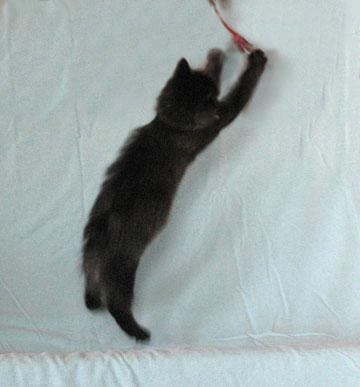
Opie plays @ Happy CatsYour cat will probably get bored quickly with any toy that just sits there. Who wouldn’t? Your best investment is a toy that has you on the other end of it, making playtime a partnership full of surprises. The more you play with your cat, the more your cat will want to play.

You can make your own cat toys from common materials or buy commercial ones that appeal to your cat. Experiment with different motions that imitate the movements that attract cats in nature.

You might have a cat who likes bird motions with fluttering, swooping air dynamics or you might find that scurrying a toy across the floor and hiding under furniture excites the cat’s hunting/playing instincts. Some cats like lots of rapid motion; others will be intimidated by so much activity.

Test your cat’s reaction to the following and find a few that will get your feline raring to play. We recommend and use the following toys for all our cats.

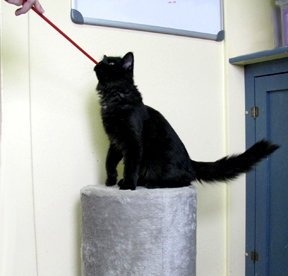
Pixie plays @ Happy CatsWAND TOYS: Cat Catcher, Cat Dancer, Da Bird, fishing pole designs, peacock feathers, string-on-a-stick

The idea is to find or make something that allows you to excite your cat’s hunting instincts when you wave, flutter, twitch, or circle the toy. You can get big movements and keep your hands away from the hunting cat.

If your cat isn’t going after a string toy, try snipping off the toy on the end, leaving the string. Almost all cats love a string.

Remember to put the wand away out of sight after playtime. This will keep the cat excited about the play sessions. It also keeps you a critical part of the sessions and builds your relationship. Check toys for loose parts that might be harmful if swallowed and replace as needed.

BALL TOYS: wadded-up paper, Mylar crinkle, ping-pongs, sponges, felted balls, large pom-poms

The movement of a ball along the floor mimics the scampering of small prey animals. Many cats like to bat, kick, bite, drop, and carry these toys. You can increase the attraction with balls that have bells, treats or catnip inside to stimulate the play. Some cats will learn to bounce the balls into a basket, play soccer in the tub or play fetch with you and the ball. These toys should also be rotated to keep them interesting.

Morrison plays @ Happy Cats
TIPS
Watch the signals
Play at your cat’s pace and watch the body language so you don’t overexcite the cat. If a cat gets too worked up, he or she could redirect their energy towards your hands or feet or another cat. Encourage play but be ready to take a break if things get too wild.

Don’t use your hands
If you use your hands to play with your cat you are teaching them to treat you as prey, so scratches and bites are likely to occur. You may think you can control the level of excitement but it is unfair to ask your cat to know the difference between play and affection.

You could be putting yourself, your cat and other humans at risk by teaching them to “attack” hands. Many cats end up in shelters because they were encouraged as kittens to bite hands or feet.

Pick a good time
Try to schedule playtime with your cat both in the morning and evening to find out when your cat is most receptive. If your play sessions are before mealtimes you mimic the natural prey sequence. Cats like routine so a play session each evening before meals will satisfy your cat’s natural drive to hunt and eat.

Careful with laser lights
Avoid using laser lights alone for play sessions, since many cats become frustrated or obsessed with chasing a light that they can’t ever catch. If you use a laser then transition to a toy or food that the cat can catch and bite to complete the natural prey drive.

One cat at a time
If you have more than one cat, try to play with them separately. If two excited cats are chasing a toy they could accidentally crash into each other and get hurt or frightened by the other cat. You might have to take the game into a room with one cat and close the door or keep two cats entertained with two separate toys (good exercise for humans too!).

No small or loose parts
Do check all toys for loose parts that might be harmful if swallowed and replace as needed. Swallowing string or other small parts can be very damaging or even fatal to cats.

]]>
https://staging.happycatshaven.org/knowledgebase/play-with-your-cat/feed/ 0 20311
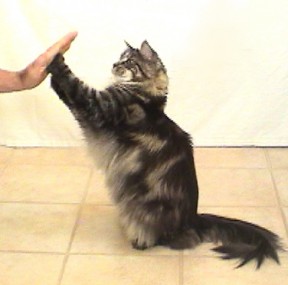
Tuna Jerky Recipe https://staging.happycatshaven.org/knowledgebase/tuna-jerky-recipe/ https://staging.happycatshaven.org/knowledgebase/tuna-jerky-recipe/#respond Fri, 10 Mar 2017 02:36:44 +0000 http://new.happycatshaven.org/?post_type=wz_knowledgebase&p=20293 Karmel High FivesOne of the biggest challenges to training a cat is finding the right treat. It’s not enough the bag screams CAT TREAT…what matters is that your cat thinks it is!

We try commercial cat treats here at Happy Cats, but the ones that most cats and kittens really go for are simple meat in some form. Cats are carnivores. Meat is the main part of their diets (or should be), so using meat as a treat is using their natural needs and instincts.

At Happy Cats, we use small spoonfuls of pure meat baby food like chicken or turkey. We also use bits of cooked chicken.

Tuna (in small amounts because of the salt) is another option. To make it easier to handle, we dry it in the microwave, making Tuna Jerky.

Tuna Jerky

1 can tuna, water packed

    • Drain the water from the tuna.
    • Spread it on a plate or cookie sheet, breaking up the flakes but not too small.
    • Cover with a paper towel.
    • Microwave on half power for 3-5 minutes, depending on the strength of your microwave. You want the tuna bits to be somewhat dried out but still flexible.
  • Stored in baggies or containers, this will keep in the fridge up to a week or so, longer in the freezer.

You can break it up further as you use it. Remember, use only enough treat for the cat to have a tiny taste so you can move on to the next trick!

]]>
https://staging.happycatshaven.org/knowledgebase/tuna-jerky-recipe/feed/ 0 20293
Clicker Training Basics https://staging.happycatshaven.org/knowledgebase/clicker-training-basics/ https://staging.happycatshaven.org/knowledgebase/clicker-training-basics/#respond Fri, 10 Mar 2017 02:35:57 +0000 http://new.happycatshaven.org/?post_type=wz_knowledgebase&p=20291 Clicker training is not your Grandpa’s obedience training. You don’t force the cat to do anything. This means your cats choose to do the behavior instead of being coerced, which makes them think and learn for themselves. It also makes them your partners in training, rather than your subjects. It’s not about obedience. It’s about learning. And fun!

It’s quieter at first. The click tells them what to do, not your voice. There’s no point in barking commands at someone who hasn’t been taught yet what the command means. When the cat proves it knows the behavior by voluntarily doing it 8 times out of 10, adding a voice command will make sense to the cat…and stick.

The first step in clicker training is to charge the clicker. In other words, charging lets the animal know the clicker is connected to a reward. As Karen Pryor says, every time you click, you’re saying, “That’s it! I’ll pay you for exactly that!” You give the cat a treat and then immediately click so the two are permanently associated. You should only need to do this a few times before the cat understands the click is connected to the treat.

Pet stores sell box clickers, but they may be too loud for some cats. Try a couple of clicks with one and if your cat reacts negatively, use either a softer clicker like the I-click, a ballpoint pen or simply your mouth. A mouth click has the advantage of freeing up your hands for treats and props, but may not be as consistent as a mechanical clicker.

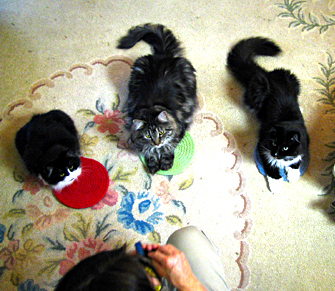
Cat clan
Clicker trainers say that animals tend to revert to their first learned behavior. Cats are hardwired to sit motionless for long periods of time when they hunt, so if you train a cat to Sit for its first behavior, you’ll have a cat who’s trained not to move. Instead, cat trainers recommend touching the target stick as a first behavior. Targeting rewards the animal for touching a stick of some kind, like a chopstick or dowel. This can be used to help shape a behavior through luring, but shouldn’t be relied on too heavily or the animal will always wait for a prompt with a prop, not offering its own behavior.

For a second behavior, many cat trainers recommend go-to-mat (let’s call it Mat for simplicity): using the prop of a mat to train the cat to go to a particular place and wait. The difference between this and a Sit is that a Sit-trained cat will tend to be glued to one place, while a Mat-trained cat can be moved around by moving the prop. It’s a variation of the Places Please behavior that Pryor describes in her book, Clicker Training for Cats.

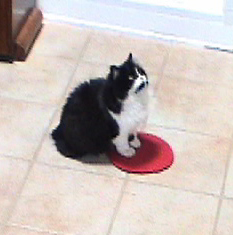
Mat can also be used to keep cats separate but engaged while waiting their turn for training (think tigers on podiums). If you have more than one cat to train, this is essential. Any portable piece of fabric works well, like a trivet or small placemat.

Another big difference between training cats and training dogs is that most dogs are very food-oriented. Most cats, being free-fed, are not. It’s a biological advantage for a solitary hunter like a cat to be suspicious of new food. Most modern cats are fed the same thing every day, so this natural tendency is reinforced. Most cats are also fed too much for their sedentary lifestyles.

Professional cat trainers recommend putting your cat on a schedule for feeding so the food becomes more valuable and so they don’t get too many calories in the form of treats. This can be disruptive for many people as well as their cats, though, so we recommend simply letting the food run out overnight and training in the morning when the cat is more food-motivated.

As for treats, this is one of the biggest obstacles to cat training, unless your cat is fairly hungry. People use commercial cat treats, freeze dried treats, cubes of cheese, bonito fish flakes and bits of chicken or tuna. We’ve found the most reliable treat for most cats is a lick of its favorite wet food or meat baby food (like Beechnut, which has no additives) off a spoon. You’ll want to feed as little as you can get away with so your cat doesn’t fill up too quickly or have digestive upsets from too rich food.

Clicker trainers have 3 ways of getting the behaviors they want: capturing, shaping or luring. Let’s say we want to train our cat to Sit. In capturing, we simply wait for the cat to get bored enough to relax and click/treat the instant its rear hits the floor. If we were to train a Spin with shaping, we might click/treat for a glance in one direction, then a look, then a partial turn, then a further turn, then a full turn, as this cat shows in this video. Some trainers don’t ever use luring because it can be difficult to fade the food in favor of the behavior. We believe there are times when a lure can be useful and still be faded, like when getting a cat to do something it might not naturally do, like sit up on its haunches.

]]>
https://staging.happycatshaven.org/knowledgebase/clicker-training-basics/feed/ 0 20291
Clicker Cheat Sheet https://staging.happycatshaven.org/knowledgebase/clicker-cheat-sheet/ https://staging.happycatshaven.org/knowledgebase/clicker-cheat-sheet/#respond Fri, 10 Mar 2017 02:35:28 +0000 http://new.happycatshaven.org/?post_type=wz_knowledgebase&p=20289 The word training can rub people the wrong way, especially cat people. Cat people know instinctively that force doesn’t work on a cat. Clicker training isn’t forceful, it’s joyful. It really should be called Clicker Play because that’s how your cat will think of it. We’ve never seen a cat who understands the contract not want to play the game.

Clicker training sets up a contract between you and the cat: if they do certain things, they get a click then a treat. Cat translation: if I do certain things, I can train my human to click then treat…how cool is that?!

The BIG TWO Rules:

1. The click marks the behavior, telling them exactly what you’re paying for. But remember: it also stops the behavior.

2. If you click, you must treat: that’s the contract. Most dogs are hardwired to love praise & pets, but cats usually need food to pay attention to the lesson. The click goes deeply & quickly into the brain–just like fear only joy–and the treat makes it stick.

How cats differ from dogs:

The treat must be valuable. For many cats, the most valuable treat is probably a lick of their favorite wet food off a spoon or from your hand or maybe bits of tuna or chicken. Commercial treats are very handy, but most cats are indifferent to them unless raised with a certain type. They’re also usually way too big. Break them up into tiny bits and use as little treat as you can get away with.

Train in several small sessions. Cat tummies are usually smaller than dogs and they lose interest when full.

How to start:

First, Charge the Clicker. This just means pairing the click with a treat in the cat’s mind. Feed the cat the treat a few times (not more than 6-8) while clicking as the cat is eating (C/T or Click/Treat). Very soon the cat will start to anticipate the wonderful thing that’s about to happen when you click.

Never ever teach a cat to Sit as its first behavior. Animals will default to their first learned behavior. Cats are hardwired to sit very still while hunting, so if you teach a Sit, you’ll end up with a cat who thinks you’re rewarding it for not moving. Always teach a prop behavior, like Target or Mat, first so you can take away the prop.

Samson touch!
Next, teach Target. Find a small stick, like a long chopstick or end of a cat teaser. Place the stick in front of the cat. Most adults will naturally lean to sniff the stick. The instant you have nose to stick contact, click. Try to treat within 2 seconds or less. If you hold the clicker and a few treats in the same hand, you’ll have less risk of intimidating some cats with a click in the ear. You don’t want the click to be a scary thing.

Some cats, especially kittens, will want to play with the stick. This is OK for a time or two, but you’ll need to fade this behavior quickly by not rewarding it and wait for the nose to touch the stick instead. The paw touches will fade if they’re not rewarded, while the nose touches will increase.

Target is especially useful for getting cats to move where you want them to go of their own choice. Anyone who’s ever tried to force a cat to go somewhere it doesn’t want to will appreciate this.

Moxie on mat
Next, teach Go to Mat. Pick a small flat mat like a large trivet, mouse pad or washcloth, but make sure it’s something you like because you’ll likely be using this for a long time.

Place the mat in front of the cat. Wait for the cat to step on the mat by itself. If it shows little interest, walk around with the mat between you and the cat, calling its name, and watch for that first step on the mat. The second the paw touches the mat, click then feed the treat away from the mat. You want the cat to choose to go to the mat, so don’t feed it on the mat at first. When the cat is reliably touching the mat, up the ante by not C/T until the cat touches with 2 feet, then C/T for a few times. When that’s reliable, again stop C/T until you get 3 feet, then 4. Congratulations…you’ve just learned how to shape a behavior!

If your ultimate goal is for the cat to sit on the mat, reward him on it once he’s doing that. Then use your Target to reward him for moving away. When he chooses to go sit on the mat, reward him again. Keep repeating this until he’s choosing to go sit on the mat 8 times out of 10. When he’s doing that, start adding your verbal command (Go to mat! or just Mat!) as he’s sitting on the mat.

If your ultimate goal is for the cat to lie down on the mat, you’ll have to shape small steps toward that or wait until he gets bored enough to lie down. The second he does, C/T.

End the session by saying Release! and slipping the mat from under the cat. Put the mat away till next time.

You’ve just learned how to both capture and shape other behaviors. Both these behaviors are the foundation for many more. Find out more here or grab yourself a book on Clicker Training cats and let the games begin!

]]>
https://staging.happycatshaven.org/knowledgebase/clicker-cheat-sheet/feed/ 0 20289
Clicker Play for Cats https://staging.happycatshaven.org/knowledgebase/clicker-play-for-cats/ https://staging.happycatshaven.org/knowledgebase/clicker-play-for-cats/#respond Fri, 10 Mar 2017 02:34:48 +0000 http://new.happycatshaven.org/?post_type=wz_knowledgebase&p=20287 It used to be thought the word cat and the word training didn’t go together. Most older books on cats will tell you it’s too difficult or not even possible. Training, in them, meant punishing to stop a behavior, not teaching to create new ones.

Thor's high fiveThen came clicker training. It developed out of research by behaviorist B.F. Skinner in the 1940s when he taught a pigeon how to bowl. He and his students showed that a behavior could be modified not only with rewards but by using a noise to bridge the reward to the behavior.

Fifty years later, clicker training was brought back into the companion animal world by Karen Pryor, who had used it with marine mammals. You can’t scruff a whale, so more effective methods than punishment were developed. Clicker training uses positive reinforcement almost exclusively.

In conventional training, the animal is given a command and then forced into doing it often enough that it begins to associate the command with the behavior. Most people with cats have had the experience of trying to force a cat to do something: it just doesn’t work, even with punishment. Most cats, like wild animals, will move into fear mode or just shut down. When the fear center is activated, your relationship with your cat can be permanently ruined.

Clicker training sets up a contract between you and your cats. If they do certain things, they get a click then a treat. Cat translation: if I do certain things, I can train my human to click then treat me…how cool is that! With clicker training, the cat is your partner in learning, a completely different role than conventional training.

It also develops a new language for communicating with your cat. You become more valuable to your cat in a way you probably wouldn’t have thought possible. Your cat will become more confident and have more confidence in you (especially good for shy cats). While we also recommend the use of just food rewards in some situations, clicker training has been proven to work up to 40% faster. This gives you an edge in solving any problems and the best chance at a positive, harmonious relationship with your cat.

Still don’t believe it? Let the cat clan show you how fun clicker play can be:

Ready to get started? See our helpful how-tos:
Clicker play for cats cheat sheet

Clicker training basics

Tuna jerky recipe

]]>
https://staging.happycatshaven.org/knowledgebase/clicker-play-for-cats/feed/ 0 20287
How to Leash Train Your Cat https://staging.happycatshaven.org/knowledgebase/how-to-leash-train-your-cat/ https://staging.happycatshaven.org/knowledgebase/how-to-leash-train-your-cat/#respond Fri, 10 Mar 2017 02:33:14 +0000 http://new.happycatshaven.org/?post_type=wz_knowledgebase&p=20285 Josie goes for a walkYes, you can train a cat to walk on a leash! Just like anything else, cats need gentle instruction to learn do something that’s foreign to them.

We hear people say they’ve tried halters or walking jackets and their cat doesn’t like them. Cats who have never experienced anything on their backs will often act as if they’ve been caught by a predator: they either flatten and freeze, or fight back.

Unfortunately, this is one of the most famous videos of a cat on a leash, clearly an example of what NOT to do, slapping a leash on an obviously frightened feline: Pinky freaks out

Instead, look at Josie on her walk: confident, comfortable and ready to play and experience the great outdoors…safely.
Josie goes for a walk
Happy Cats volunteer and Play & Treat Pet Services’ Melissa Shandley has written a great guide to get you started on leash training your own cat. If you have any questions, please feel free to give us a call at 719-362-4600.
Isaac on a walk

Why should I leash train my cat?

Many cats live indoors to keep them safe, preventing injuries, illness and premature death. Indoor cats may get bored, obese and develop undesirable behaviors if they don’t have mental and physical stimulation.

A cat that is harness & leash trained has more options for safely traveling and spending time outdoors. The opportunity to spend time walking in the neighborhood can increase a cat’s confidence since they can expand their territory. You can enjoy the experience of having your cat with you in the yard or on the deck.

A cat that is satisfied and well exercised will be a calm and pleasant housemate for you and other animals in the home.
Pepsi on a walk

How to introduce the leash & harness

Each cat will have their own unique reactions to harness training and these steps should be modified to fit your cat’s response.

  1. Allow your cat to get familiar with the harness and leash by placing them in your cat’s sleeping area for a few days.
  2. Distract your cat with treats or a toy when placing them in the harness. Be sure to make the experience positive. Save these favorite rewards and only offer them during training.
  3. The harness should fit snugly, but allow free movement. It is not safe to walk cats on a traditional collar.
  4. If your cat shows any behavior that indicates the experience is unpleasant for them, reassure them and take the harness off. You can try again later; forcing your cat will just give them a bad association with the harness. Also end the session if you get frustrated.
  5. Walk with your cat around the house at first until he or she is comfortable in the harness. Introducing the cat to the outdoors is a completely different step and should be done slowly.
  6. Choose a safe quiet location to walk your cat. Help motivate your cat by getting the harness associated with some desirable activity like going outside, playing with a favorite toy or getting a desirable treat.
  7. If your cat has never been outside, you’ll need to train him or her to be comfortable outside the house with these training tips first.
  8. Once your cat is comfortable with going outside, you can pick your cat up and take him or her outside to start. This will help train your cat not to go out the door on their own. Once outside you can encourage movement with treats.
  9. If your cat gets frightened, return indoors. Never let them pull back on the harness to try to escape.
  10. The best position for you to stand is to the side and behind your cat. You can guide your cat with gentle sideways pressure on the leash.
  11. Create a signal when the walk is over: tell your cat “Home” and carry the cat indoors. Treat and reward the cat and remove the harness.
  12. Walking a cat is different from walking a dog. You will be keeping your cat safe and controlled while they get a chance to go out and investigate. Don’t let them get too far away, especially if there is dense brush around. It is not safe to let a leashed cat climb trees.
  13. If your cat gets away don’t chase after them. Sit on the ground and call your cat and offer a treat. Stay calm and entice your cat to come to you.

Josie goes for a walk

What else should I know?

Train when your cat is hungry and motivated by treats. Have a good supply that you can easily offer to reinforce your cat’s efforts.

Many cats will fall over or freeze when they feel the harness because it triggers a survival response that they would employ if grabbed by a predator. You need to help them move through this instinctual behavior with a highly attractive motivation – toy or treat — and lots of praise.

Go slow and reward your cat for small advances. The training will be more successful and you will be out enjoying the company of your leashed cat sooner if you don’t make the experience unpleasant.

If the cat pulls on out of the harness, immediately slacken the leash. This is easiest if you are standing behind your cat. If the cat gets frightened, consider picking him up and ending the session. In other situations while your cat is getting used to the harness and leash, try not to interrupt the learning process by repeatedly picking your cat up. Instead let the cat learn that the leash allows good things to happen.

Be confident and praise your cat as you place him in the harness. If you enjoy the process it will give him confidence.
Walking jacket

Additional leash & halter training resources

The following link will take you to an article featuring Jackson Galaxy consulting with a client on leash training.
Nine Lives, One Leash

Where to find safe harnesses:

]]>
https://staging.happycatshaven.org/knowledgebase/how-to-leash-train-your-cat/feed/ 0 20285
A Cat for My Dog? https://staging.happycatshaven.org/knowledgebase/a-cat-for-my-dog/ https://staging.happycatshaven.org/knowledgebase/a-cat-for-my-dog/#respond Fri, 10 Mar 2017 02:32:47 +0000 http://new.happycatshaven.org/?post_type=wz_knowledgebase&p=20283 Happy Cats recently got this very good question from our reader, Zane:
Hello, I’m looking to adopt a feline companion in the next few months. My dog is five, energetic but well-behaved, and a herding breed; she gets along with some cats and others she does not. I was wondering what age and temperament of a cat would get along best with my dog and if there is anything that I can do to prepare my dog for a new arrival. Or, would you recommend that perhaps I should not risk a violent confrontation and not get a cat at this time?Dog with kittenOur resident behaviorist and volunteer, Melissa Shandley, has a big dog, Bisbee, who was friends with the cats she had at the time. Then she got two kittens who triggered Bisbee’s prey drive. Melissa took the time to very slowly introduce the kittens, constantly monitoring and controlling the situation. Now Bisbee has two more cats in his clan and everyone is happy.

This is her answer to Zane:

Zane,
You mention that your dog does not get along with some cats and later you ask about the risk of a violent confrontation. Has your dog ever harmed a cat? If this has happened, adding a cat is a bigger risk and you would be responsible for preventing any harm, physical or emotional, from occurring. Some dogs have a very high prey drive and low impulse control. If this is the case it may not be safe to introduce a cat to your home.

Some dogs just need to learn manners around cats. An adult cat who will stand their ground rather than running away can help a dog adapt. There are training methods for introducing cats and dogs. You may need to consider if you have the time to get educated and are willing to take the necessary precautions to protect both animals during the adjustment period, which could be several months.

Giving the dog a toy can help the dog release some of their excitement and prevent them from getting to physical with the cat. In the YouTube series below, you can see how Nova, the dog, plays with the tennis ball. This helps her have a positive experience before introducing the game to the new kitten, Coffee. When I was introducing Bisbee to two fearless kittens, I encouraged him to search out one of his stuffed animals to mouth and shake. He instinctively does so on his own now when the cats initiate play. This is a good way to allow the cat and dog to enjoy playing together.

Here are some resources to get you started, including those videos. One important thing to point out is the human needs to be calm and relaxed to convey that to the animals. Until their desensitization when the animals can be relaxed with each other, the human needs to maintain control with the dog on a leash or one of them in a crate.

A UK trainer shows the behavior of her high-prey-drive dog Nova with her new kitten Coffee. In just a few days with good safe introductions, she is teaching them to do tricks together (scroll down to the bottom for the first video, “Dog/Cat introduction – Door Frame part 1, Day1”):

A very thorough article by Jackson Galaxy

Another from the American Humane Association

Dr. Sophia Yin trains her dog Jonesy to be around her chickens

If you have more questions, Zane, you can email Melissa or go to her website. Good luck and come visit once you are comfortable with keeping everyone safe!

]]>
https://staging.happycatshaven.org/knowledgebase/a-cat-for-my-dog/feed/ 0 20283
Declawing: Before You Take Away Their Claws https://staging.happycatshaven.org/knowledgebase/declawing-before-you-take-away-their-claws/ https://staging.happycatshaven.org/knowledgebase/declawing-before-you-take-away-their-claws/#respond Fri, 10 Mar 2017 02:31:18 +0000 http://new.happycatshaven.org/?post_type=wz_knowledgebase&p=20281

Angel @ Happy Cats

Please get the facts if you are considering declawing!

Cats are born with the claws nature intended them to have:

  • They scratch to tell other cats about their territory with scent instead of aggression and marking.
  • Cats need claws to stretch and strengthen their whole bodies, to climb to safety and to balance.
  • Cats use their claws to knead, to comfort themselves when stressed.

Cats can be trained to scratch on acceptable surfaces:

  • Cats have individual preferences for scratching, including textures and surface alignments.
  • Scratchers come in all shapes and textures to help you find ones they like, as well as ones you can live with.
  • You can make scratching a fun habit by rewarding them with treats like catnip when they use the scratcher instead of your furniture.

Facts about declawing:

  • Declawing is amputating the last bone in each toe, along with severing tendons, nerves and muscles that enable normal feline movement.
  • During the surgery–even when anesthetized–cats often moan aloud as there is no anesthetic strong enough to remove the deep bone pain that declawing causes.
  • Declawing makes using the litter box painful for cats, which can cause them to not want to use the box.
  • Declawing takes away an important form of communication, leaving them no other option than to bite.
  • Declawing can make cats more shy or aggressive, knowing they can’t defend themselves.
  • Declawing leads to premature arthritis in their backs and lameness as they age.
  • Cats with claws are no more likely to injure a declawed cat than another declawed cat is; it’s all about matching the right cats with each other.
  • Declawing is used by drug companies to test new pain medications, as there is no more painful procedure known.

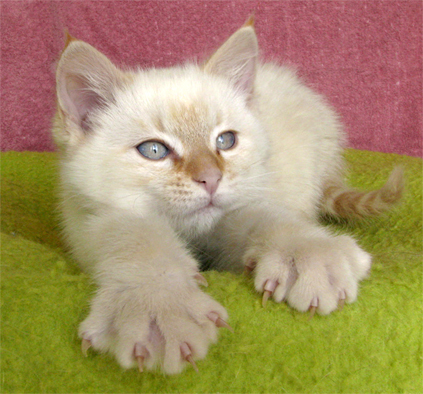
Cats come with clawsDeclawing is mutilation that sets up a cat for a lifetime of pain that often leads to behavior that lands them in shelters. We know; we’ve seen it. Happy Cats Haven is proud to work with veterinarians who only perform these amputations as a very last resort.

There are ways to solve scratching issues; we can help you find alternatives to declawing. Please call us at 719-362-4600 or email us directly!


]]>
https://staging.happycatshaven.org/knowledgebase/declawing-before-you-take-away-their-claws/feed/ 0 20281